


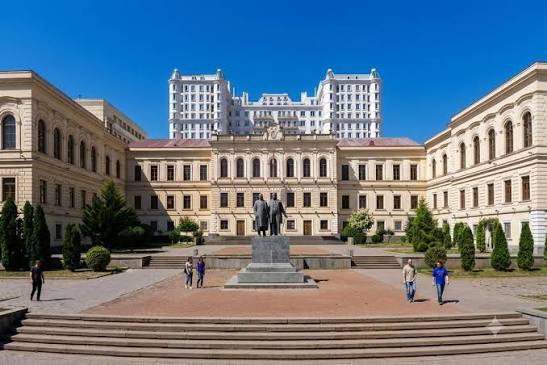
A Country That Has Quietly Transformed Its Medical Education Sector
When students and parents first hear “MBBS in Georgia,” the response is often a question about the country’s location and standing. Georgia — the country nestled between Russia and Turkey in the South Caucasus, not the American state — has spent the past two decades systematically building a medical education infrastructure that now attracts students from more than seventy countries. This transformation did not happen by accident. It resulted from deliberate policy choices: liberalising higher education, inviting international investment in university campuses, adopting internationally aligned curricula, and seeking recognition from global regulatory bodies including the World Health Organization and the National Medical Commission of India.
For Indian students in particular, Georgia has emerged as a genuinely compelling option — and not simply because it is cheap. The combination of WHO-listed and NMC-approved universities, English-medium instruction, a five or six-year MBBS programme, European clinical exposure, and a cost structure that is a fraction of private medical colleges in India creates a value proposition that is difficult to match in other popular destinations.
Recognition That Makes Your Degree Count Back Home
One of the first questions families ask about MBBS in Georgia is whether the degree will be recognised when the student returns to India. This is entirely the right question, and the answer is reassuring for students who do their due diligence. Several Georgian medical universities are listed with the World Health Organization and are recognised by the National Medical Commission of India — which means graduates are eligible to appear for the Foreign Medical Graduates Examination (FMGE) and, after clearing it, to practise medicine in India. This regulatory clarity is important: it means Georgia is not a shortcut around Indian medical regulation, but a legitimate path to an internationally valid medical degree that can be brought back home.
The same recognition extends across many other countries. Georgian medical degrees from recognised universities open doors in the United States (with USMLE eligibility), the United Kingdom (with PLAB eligibility), and across Europe and the Middle East. This international portability is one of the most significant advantages of studying at an accredited Georgian institution — students are not locking themselves into a single career geography when they choose Georgia.
The Cost Advantage Is Real and Substantial
Private medical colleges in India that offer MBBS seats outside the government quota can charge anywhere from fifty lakhs to over one crore rupees for a full course. For many families who cannot secure a government seat through NEET but want their child to study medicine, this cost is prohibitive. Georgia changes the equation dramatically. The total cost of studying MBBS in Georgia — including tuition fees across the entire programme, accommodation, food, and personal expenses — typically falls in the range of twenty-five to forty lakhs for the full duration, depending on the university and the city.
This is not a case of paying less and getting less. Georgian medical universities teach English-medium programmes using curricula that include substantial pre-clinical science education followed by clinical rotations in university-affiliated hospitals. The infrastructure at established Georgian medical universities is modern, the faculties include both Georgian professors and international faculty, and the clinical exposure in Georgian hospitals — where English is widely used in academic settings — gives students genuine bedside learning rather than observation from a distance.
Life in Georgia as an International Student
Tbilisi, the Georgian capital where most medical universities are located, is a genuinely enjoyable city for international students. The cost of living is low by any measure — accommodation in student residences or private apartments is affordable, food is inexpensive, and public transport is convenient and cheap. The city is safe, relatively compact, and has a growing international student community that gives arriving students an established network to connect with almost immediately.
Georgia’s climate varies by region but is generally moderate, with warm summers and cold winters in Tbilisi. The country is geographically small and well-connected to Europe, making travel during semester breaks practical and affordable. For students from South Asia, the absence of long-haul travel distances is a practical quality-of-life advantage that adds up over six years of study. Flight connections from major Indian cities to Tbilisi are available with one stop, and the journey time is manageable for semester-start returns and holiday travel.
The FMGE Pass Rate Question
Indian students considering Georgia are right to ask about FMGE pass rates — the examination that NMC-recognised foreign medical graduates must clear to practise in India. The honest answer is that FMGE pass rates from Georgia, like those from most foreign MBBS destinations, require significant dedicated preparation alongside the degree programme. The degree alone is not sufficient preparation for FMGE; students who take the examination seriously and invest in targeted FMGE preparation during and after their programme consistently achieve better outcomes than those who approach it as an afterthought.
The good news is that Georgian universities with strong academic standards — where the teaching, clinical exposure, and examination standards genuinely prepare students — produce graduates who are better positioned for FMGE success than those from less rigorous programmes. Choosing the right university within Georgia, rather than simply the cheapest option, is therefore one of the most important decisions in the MBBS in Georgia journey.
Making the Right Choice Within Georgia
Not all Georgian medical universities are equivalent in quality, recognition status, or student support infrastructure. Students should specifically verify that their target university is on the WHO list and is recognised by the NMC of India before applying. They should research the university’s clinical training facilities, the languages in which theoretical and clinical instruction are delivered, and the university’s track record with international students from India. Connecting with current students or recent graduates through verified channels provides insight that university marketing materials do not always reflect accurately.
For students who are serious about medicine and willing to invest in thorough preparation — for both the degree programme itself and for FMGE after graduation — Georgia offers a legitimate, affordable, and internationally recognised path to a medical career. That is a genuine opportunity that deserves more serious consideration than many Indian families give it.

